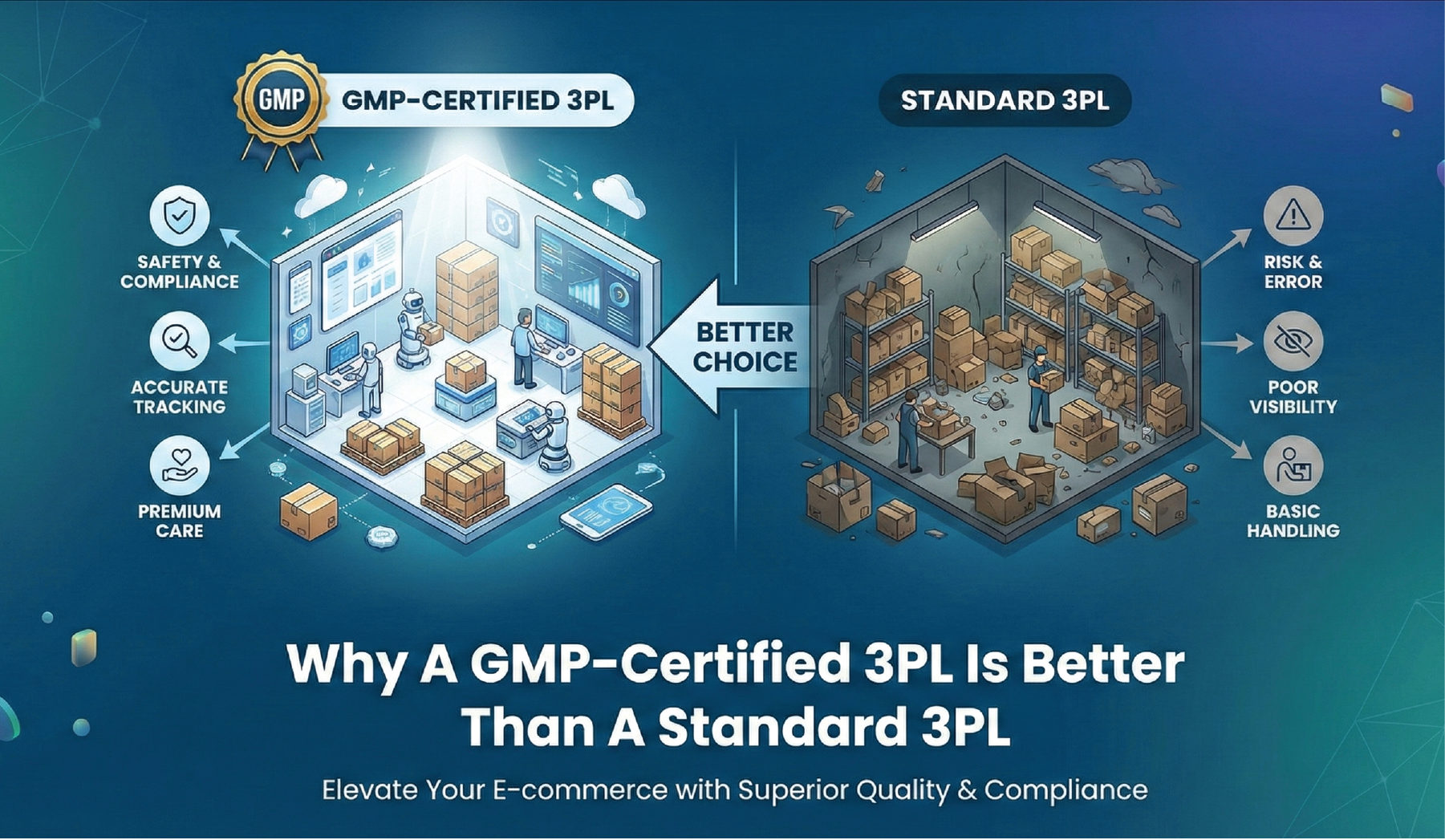
A GMP-certified 3PL (Good Manufacturing Practice) operates under strict, FDA-regulated guidelines (21 CFR Part 111) ensuring products are stored, handled, and shipped in a sanitary, climate-controlled, and traceable environment. Unlike a standard 3PL, which focuses primarily on speed and storage density, a GMP facility prioritizes product integrity, hygiene, and consumer safety.
Key Advantages of GMP Certification:
Let’s be honest for a second. When you started your brand, whether you’re mixing pre-workout powder in your kitchen or sourcing the finest organic face creams from Korea, you probably weren’t dreaming about warehouse sanitation logs. You were dreaming about five-star reviews, viral TikToks, and sales notifications pinging your phone at 3 AM.
But here we are. You’re scaling up. Your living room is no longer a viable shipping center, and you’re looking for a partner to handle the heavy lifting. You type "fulfillment center" into Google, and you’re hit with a million options. Some promise rock-bottom rates; others promise lightning speed.
Here is the cold, hard truth: Not all warehouses are created equal.
There is a massive, often invisible divide in the logistics world. On one side, you have the "Standard 3PL", basic warehouse shipping operations that treat your premium collagen peptides the same way they treat a box of rubber mallets. On the other side, you have the GMP-Certified 3PL.
If you are in the business of health, wellness, beauty, or food, the difference between these two isn’t just about cleaner floors. It’s the difference between a thriving business and a mandatory FDA recall that bankrupts you.
Today, we are going to deep-dive into the unsexy but critically important world of GMP (Good Manufacturing Practices). We’ll explain why Shopify fulfillment requires a higher standard of care than you might think, and why upgrading your logistics partner is the smartest insurance policy you’ll ever buy.
Before we start throwing stones at the "standard" guys, let’s define our terms. GMP stands for Good Manufacturing Practices.
Now, you might be thinking, "Wait, I’m looking for a shipping partner, not a manufacturer. Why do I care?"
Great question.
While GMP started in manufacturing, the FDA (and common sense) realized that if you make a pristine, safe vitamin pill in a lab, but then store it in a damp, rat-infested warehouse for six months before shipping it to a customer, that pill is no longer pristine. It’s a health hazard.
You’ll often see it written as cGMP, where the "c" stands for current. This is the FDA’s way of saying, "Don't use the standards from 1985." It requires companies to use technologies and systems that are up-to-date.
For a 3PL (Third-Party Logistics) provider, GMP certification means the facility complies with regulations enforcing:
It is a holistic approach to quality. A standard warehouse focuses on speed and storage. A GMP warehouse focuses on safety and integrity.
Or, "What happens when nobody is watching?"
To understand the value of GMP, you have to look at the alternative.
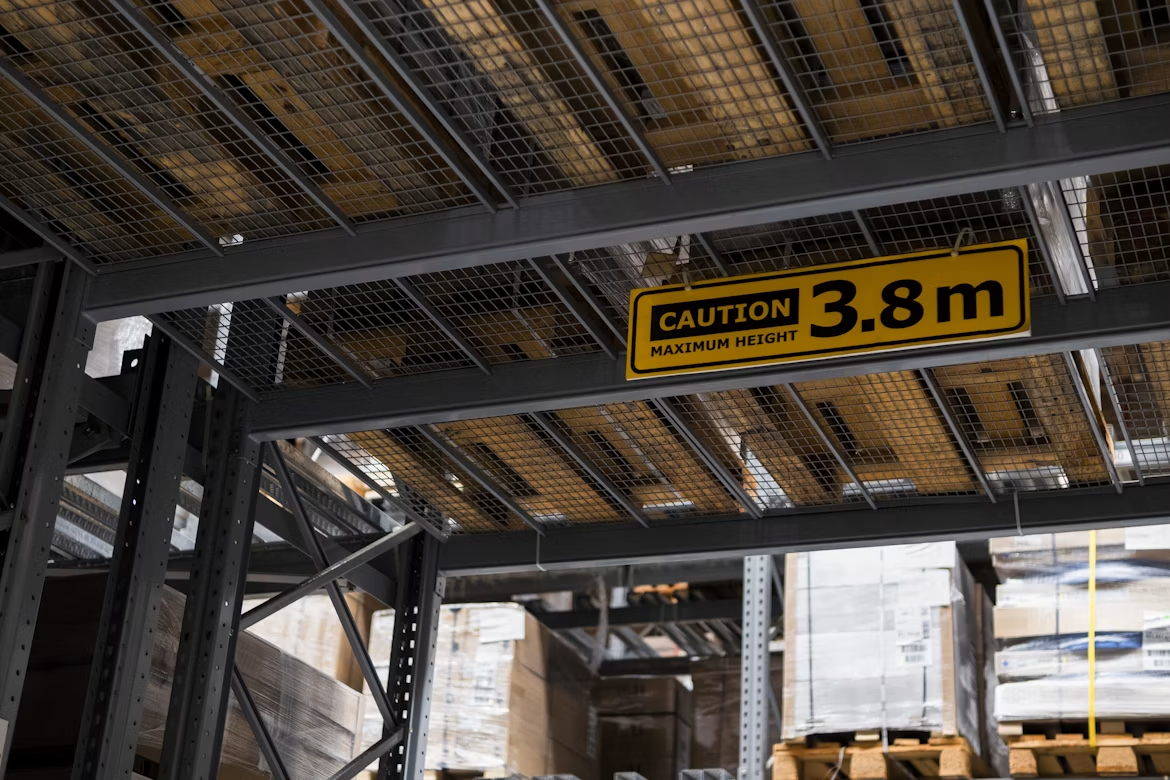
Imagine a standard, non-certified warehouse. It’s a massive concrete box. It’s dusty. In the summer, it gets hot, maybe 90°F or more inside. In the winter, it’s freezing.
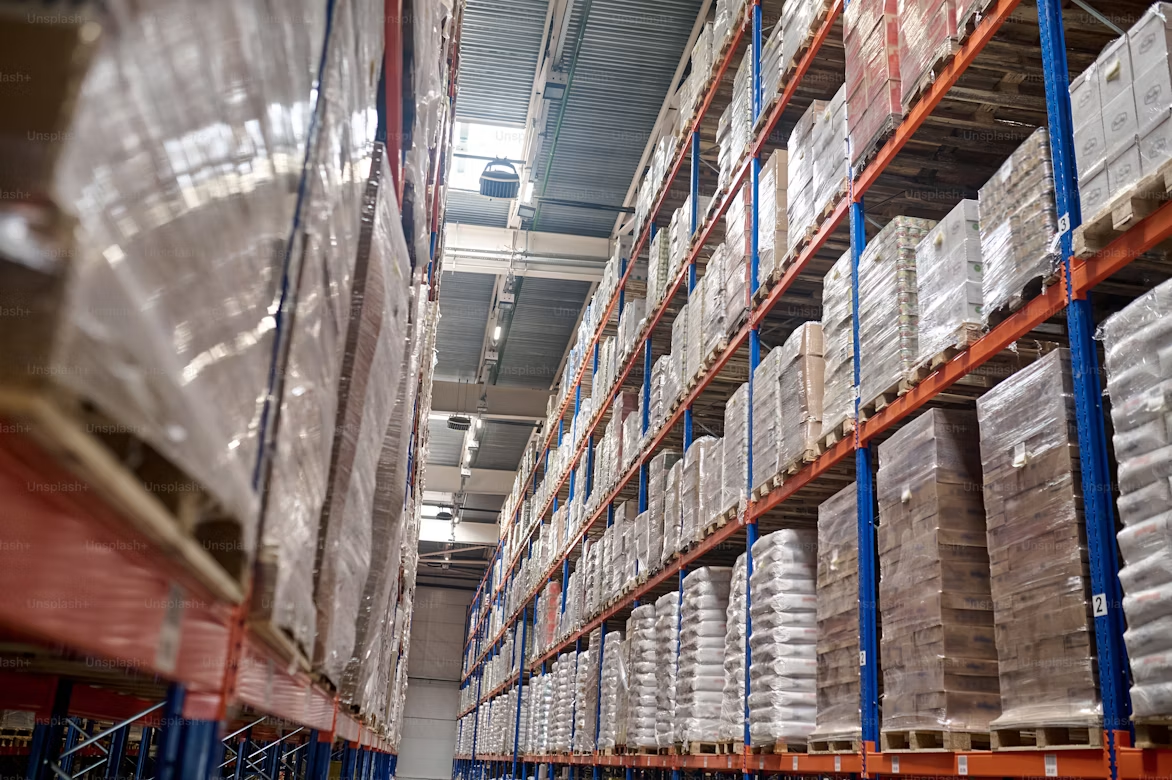
In a standard facility, your pallets of organic protein powder are sitting on racks next to... well, who knows? Could be tires. Could be pet food. Could be scented candles that leak fragrance oils into the air.
There is no regulatory requirement for a standard 3PL to monitor humidity. If it rains for a week and the air gets thick with moisture, your powdered supplements might start clumping inside the jar before they even leave the shelf.
In a standard setup, inventory management is often "loose."
We don't like to talk about it, but warehouses have big doors. things crawl in. In a GMP facility, pest control is a religion. In a standard facility? It’s often an afterthought handled by a guy named Steve with a spray can once a month.
Reality Check: If you are selling t-shirts, a standard 3PL is probably fine. Dust shakes off. But if you are selling something that goes in or on a human body, "probably fine" is not good enough.
Let’s break down exactly what you get with a GMP-certified partner like ShipBots, and why it justifies the shift from a standard provider.
This is the big one. Under FDA regulations (specifically 21 CFR Part 111 for supplements), a physical plant must be maintained in a condition that protects against contamination.
In a standard warehouse, the training might be, "Here’s the tape gun, that’s the box, go fast."
In a GMP facility, everything is governed by SOPs.
SOPs remove the guesswork. They ensure that the 1,000th order is packed with the same care as the 1st order.
This is where the rubber meets the road for warehouse management.
Imagine this nightmare: You find out that Batch #402 of your magnesium supplement has a seal defect.
Many GMP facilities offer temperature and humidity monitoring. This is crucial for:
According to a study on supply chain risks, environmental excursions are a leading cause of product spoilage in the nutraceutical sector. A GMP warehouse monitors this 24/7.
You might be thinking, "I don't sell prescription drugs, do I really need this?"
If you fall into any of these categories, the answer is a resounding YES.
The nutraceutical market is exploding, projected to hit nearly $550 billion by 2025 (Source: Persistence Market Research). But with growth comes scrutiny. The FDA is cracking down on "garage brands." If you can't prove your supply chain is secure, you are a target.
Using a GMP 3PL gives you a "Chain of Custody." It proves that from the moment the manufacturer made the pills to the moment they left the warehouse, they were safe.
Cosmetics are less regulated than drugs but more regulated than t-shirts. Plus, the customer base is ruthless. If a customer receives a face cream that smells "off" because it sat in a hot warehouse, they won't just return it; they will post a video about it.
Protein bars, energy drinks, mushroom coffee. These are food products. They attract pests. They spoil. They require FEFO (First-Expired, First-Out) logic, not just FIFO.
We talk to business owners every day who say, "But this other 3PL is 10 cents cheaper per pick."
Let’s do some math.
The Cost of "Cheap":
The GMP ROI: You pay a premium for a GMP partner because you are paying for insurance. You are paying for the lights to be on, the floors to be scrubbed, the staff to be trained, and the software to be accurate.
Pro Tip: Don't look at fulfillment as a "cost center" to be minimized. Look at it as a "growth engine." If your logistics are flawless, you can scale without fear.
Let’s pull back the curtain on a day in the life at a facility like ShipBots.
A truck arrives with 10 pallets of your new "Brain Boost" nootropic.
The pallets are moved to their designated zone.
Orders are flowing in from your Shopify store.
Maybe you have a "New Year New You" bundle.
The carriers arrive (UPS, FedEx, USPS).
You don't need to be a lawyer, but you need to know the basics.
This is the bible for dietary supplements. It mandates that you must have a system to ensure the product meets specifications for identity, purity, strength, and composition.
The FSMA shifted the focus from responding to contamination to preventing it. It requires hazard analysis.
This is new and big for beauty brands. MoCRA gives the FDA more power to recall cosmetics and requires serious adverse event reporting.
So, you’re convinced. You want a GMP partner. How do you spot the fakes? There are plenty of warehouses that say they are "clean" but don't have the certifications.
Ask these questions during your sales call:
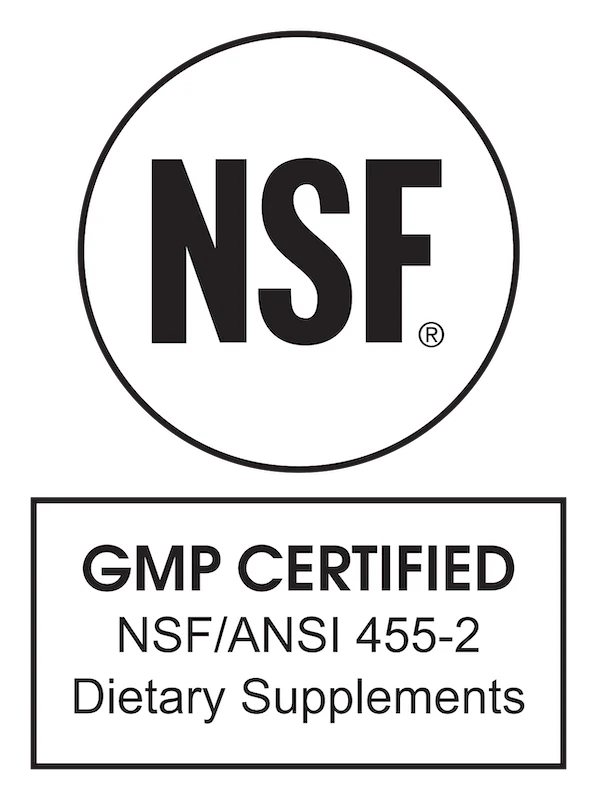
Okay, let’s talk about us for a second. There is "GMP compliant," and then there is NSF GMP Certified. ShipBots holds the latter.
For those not deep in the audit world, NSF is the highest standard achievable among all audit organizations. It’s a rigorous, third-party validation that proves our facility operates at the absolute peak of safety and quality.
At ShipBots, we recognized early on that the future of ecommerce was moving toward premium, high-stakes products. People aren't just buying fidget spinners anymore. They are buying supplements, medical devices, and high-end apparel.
We built our infrastructure to handle the hard stuff.
We also understand that returns are a pain.
Here is a weird psychological trick: When you know your backend is secure, you market better.
When you are constantly worried that your warehouse is going to mess up an order, you unconsciously hold back. You don't push that ad spend as hard. You hesitate to reach out to that influencer.
When you trust your partner, when you know that ShipBots has your back with GMP-certified rigor, you can take the brakes off. You can scale aggressively because you know the infrastructure won't crack.
It’s the peace of mind factor. And in the chaotic world of entrepreneurship, peace of mind is priceless.
You can choose the warehouse that looks like a garage sale, where the "inventory system" is a guy named Dave with a clipboard and a vague memory of where he put the boxes. It might save you a few pennies per order in the short term.
Or, you can choose a GMP-Certified partner like ShipBots. A partner that treats your product with the same respect you do. A partner that understands that compliance is the foundation of scale.
In the world of 2026, where consumers are smart, lawyers are hungry, and the FDA is watching, cutting corners on logistics is a bet you shouldn't make.
Don't let a dirty warehouse destroy what you've built. Upgrade to a facility that meets the highest standards of safety, hygiene, and accuracy.
Your brand deserves the best. Your customers deserve the safest.
Ready to sleep better at night? Let’s get your logistics compliant and scalable.





.svg)




.jpg)
.jpg)






.jpg)
















.jpg)