Climate controlled fulfillment for medical devices means storing, picking, packing, and shipping regulated device inventory in a facility that holds temperature and humidity inside each product's labeled range. It watches those conditions around the clock. It logs every excursion. And it tracks every lot and serial number from the dock to the customer's door. Get it wrong and you lose two days off every order cycle and roughly 13% of the margin you should be keeping. That is the gap temperature controlled fulfillment is built to close.
Neither number is abstract. Two days is what slow receiving and an extra transit zone quietly add to your cycle. The 13% is the savings brands see when they leave a warehouse that was never built for regulated product. Read it backwards. It is what the wrong warehouse charges you each month without putting it on the invoice.
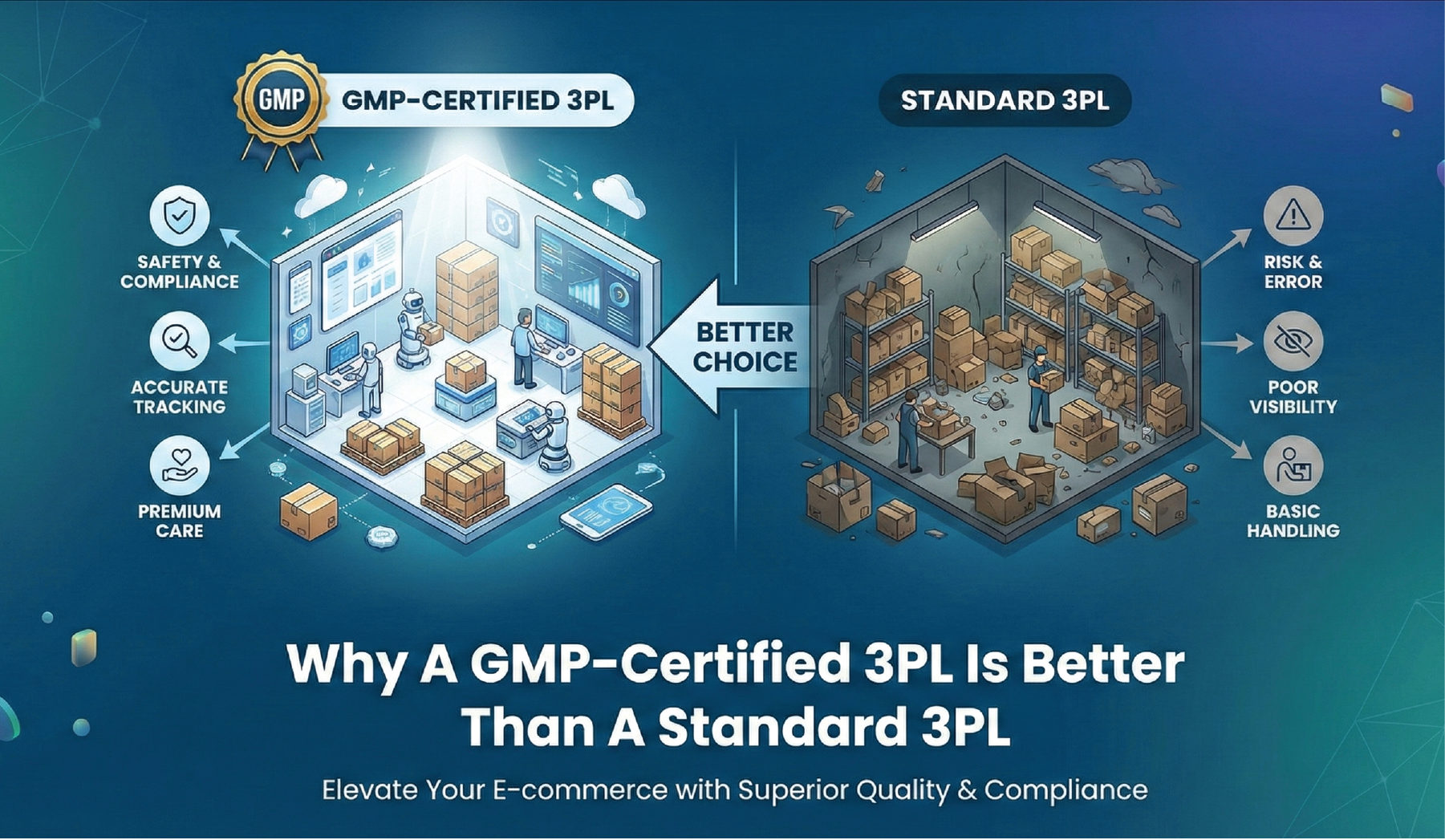
Device brands hit this wall sooner than most. That is why so many start at a GMP certified fulfillment facility, then build their order fulfillment services around it. Picking a 3PL logistics partner is the first real quality call most device brands make
Nobody loses two days in one dramatic event. It comes off in pieces. Most brands never see it because the pieces sit in different reports.
Receiving is the most overlooked delay in fulfillment. A container arrives. It gets broken down. Then it waits for someone to count it, verify it, capture lot and expiration data, and put it away.
In a generalist warehouse, that queue often runs three to five days. Every hour in it is an hour on a dock that hits 95 degrees in August.
Fast dock to stock is not a vanity metric here. It decides whether you have sellable stock or a lot with a thermal history you have to explain. ShipBots receives within 48 hours, and that is where the first day comes back.
The second day is geography. A warehouse two zones farther from your buyers adds a day to ground transit on most orders. Then it pushes you to upgrade service levels to cover the gap.
Choosing a 3PL location against your real order data is the cheapest speed gain available to any brand. Picking one against the lowest storage rate is how the day gets lost in the first place.
Splitting inventory across coasts compounds the gain. ShipBots runs fulfillment center locations on both U.S. coasts. The Los Angeles facility sits minutes from the Port of Long Beach, which shortens the trip from container to controlled storage for imported device lines.
There is a day you only lose sometimes, and it costs the most. It is quarantine.
When a temperature excursion hits, the affected lot locks until your quality team makes a disposition call. If the warehouse cannot pull the logged data quickly, that call waits. Picked orders get cancelled, and a delay turns into a stockout.
The 13% is the cost savings brands see after moving to a facility built for their product. Read in reverse, it is a charge you are already paying. It shows up in four places.
A device that sat outside its labeled range does not get discounted. It gets destroyed and documented, and in some cases reported.
One breached pallet of diagnostic kits can erase a quarter of your margin gains on its own. It never shows up in a shipping cost review, because it is booked as shrinkage.
Two problems stack here. A farther origin point pushes orders into higher zones. Slow receiving pushes orders toward expedited service to hit a promise date.
A 3PL that rate shops across carriers on every order and sits close to your buyers takes both back. Tracking your real cost per unit shipped, not the headline pick fee, is the only way to see the leak.
Device returns are rarely restockable by default. Anything that left controlled storage has an unknown thermal history. Those units need inspection, a documented disposition, and often destruction rather than resale.
A reverse logistics process written for apparel will quietly write off good product in this category. That is a margin problem dressed up as a customer service policy.
Every hour your team spends chasing a lot number or pulling documents for an audit is unbilled cost. It is real, it recurs, and it almost never makes the 3PL comparison spreadsheet.
Track your supply chain KPIs honestly and you will find that order accuracy and inventory accuracy say more about your margin than your storage rate does.
Climate controlled gets used loosely in warehousing. Some operators mean a roof and a swamp cooler. For devices, the term has to map to a written spec with data behind it.
Most medical devices are not cold chain products. They carry a controlled room temperature label. That is usually 20 to 25 C. Brief excursions between 15 and 30 C are allowed, as long as the mean kinetic temperature stays in range.
A standard ambient warehouse in Southern California, Texas, or the Southeast will breach 30 C for weeks at a time. That is not a rare event to manage. That is a summer.
The test is simple. Pull the storage statement off your instructions for use. Then ask your warehouse for twelve months of logged data at the exact spot where your pallets sit. If they can produce it, you have an answer. If they can only produce the thermostat setting, you do not.
Temperature gets the attention. Humidity does the quiet damage.
A facility that controls temperature but ignores humidity is solving half the problem.
Some devices need 2 to 8 C. That includes many in vitro diagnostics, reagents, control materials, and certain combination products.
Cold chain adds qualified refrigeration, redundancy, and validated shippers on the way out. It is a different service level than controlled room temperature, and it should be specified and priced separately. If your catalog mixes both, say so at the start rather than at go live.

The gap between a normal ecommerce warehouse and a device ready one is documentation as much as equipment.
U.S. device manufacturers operate under 21 CFR Part 820. As of February 2, 2026, it is harmonized with ISO 13485 through FDA's Quality Management System Regulation.
Two rules land right on the warehouse floor. Control conditions that could affect product quality. And keep storage areas that prevent mixups, damage, and spoilage.
Those duties do not transfer when you outsource. A 3PL storing your finished devices is running a piece of your quality system. So supplier controls, a quality agreement, and audit rights matter more here than in a normal fulfillment contract.
Some 3PLs carry their own FDA establishment registration. Some do not. It depends on the role they play in your chain, so get the answer in writing.
Devices carry a unique device identifier. That identifier is only worth something if your warehouse actually captures it.
When a recall or a correction and removal happens, you have days, not weeks, to find affected lots and reach the customers who got them.
That last line separates a device capable operation from a merely good one. Anyone can log a temperature. Fewer can tell you what happened to the product after the log went red.
A sterile barrier is only valid if it survives handling, stacking, and transit. Crush damage, punctures from poor void fill, and repeated restacking all break packaging that passed its lab test.
Packaging design and correct dunnage selection are quality controls in this category. They are not cost lines to shave.
Five things separate a warehouse that says climate controlled from one that can prove it.
Temperature and humidity mapping. Map the facility seasonally, with sensors at real hot and cold spots rather than in the comfortable middle of the room. Mapping tells you where product can safely live. Without it, storage assignment is guesswork.
Constant monitoring with calibrated sensors. Not a daily walkthrough with a clipboard. Constant logging, sensors on a calibration schedule with certificates on file, and data you can pull for any date range.
Alarms that reach a human. A system that emails an unwatched inbox at 2 a.m. is a box checked, not a control. The alert has to reach someone who can walk over and fix it. The response time has to be written down.
Backup power and redundant HVAC. Grid events happen. What matters is how long product stays in range without utility power, and whether the refrigeration has redundancy or a single point of failure.
Separation and hold control. Quarantine areas that are walled off and locked in the system, so held product cannot be picked. Clear paths for excursion, damage, expiry, and return stock.
The equipment is only half of it. The rest is discipline, and it shows up in how a facility handles routine warehouse inspection and daily housekeeping. The warehouses that pass audits are the ones that were already clean on a Tuesday.
Most device companies run two or three order profiles at once. Each one stresses climate control differently.
Home diagnostics, wearables, continuous glucose monitors, and refill programs ship in ones and twos to residential addresses. Volume is high, margins are tighter, and delivery speed drives reorder rates.
A single test kit going to an apartment in Phoenix still needs the same lot capture and the same storage discipline as a hospital pallet.
Clinics, buying groups, and retail buyers bring routing guides, ASN rules, labeling standards, and chargebacks when you miss them. Getting pallets, cases, and EDI paperwork right is its own skill.
That is why B2B fulfillment runs on a different playbook than the DTC side of the same catalog.
Device brands rarely ship a single part. Starter kits, refill bundles, trial packs, and practitioner samples all get built somewhere. Build them inside a controlled space and every part stays in range.
Done right, kitting and assembly services also let you build to demand instead of locking inventory into fixed configurations months ahead.
Storage conditions do not stop mattering at the dock.
A shipper qualified for 48 hours does not protect a package sitting in a regional sort facility over a long weekend. Temperature sensitive orders need cutoff discipline and a service level that clears the qualification window. Sometimes overnight shipping is the responsible option, not the premium one.
First expired first out only works when the software blocks the wrong pick. Ask how the warehouse management systems handle lot and expiration logic, and ask to see it. Disciplined stock control is what keeps short dated inventory from becoming written off inventory.
Every ShipBots order is checked against Vision AI pack verification, and the recording is kept if a customer ever disputes what arrived. That is how the operation holds a 99.999% accuracy rate across more than 3 million orders a year.
Ask for specifics. Vague answers are the answer.
Two of those carry extra weight in regulated categories. Certification claims should always be checked against paperwork, which is the whole argument for a GMP certified 3PL over a generalist with good intentions. And because cGMP compliance obligations flow through to your suppliers, the quality agreement is where your exposure actually gets defined.
ShipBots runs a temperature controlled, GMP certified, FDA registered operation with NSF International credentials. It is the same environment that supports nutraceutical fulfillment and other categories where storage conditions and lot traceability are not negotiable.
The numbers behind the recovery are specific. 48 hour dock to stock. 99.9% same day ship. 99.999% accuracy across more than 3 million orders a year. Warehouses on both coasts, and rate shopping across carriers on every order.
Your account manager sits inside the warehouse your product is in, reachable by phone, email, Slack, or SMS, including weekends. Pricing is volume based with no long term contract, because the business gets earned every month through performance rather than legal lock ins.
The only way to know what the wrong warehouse is costing you specifically is to run your real order profile, SKU count, and storage requirements against real pricing. Medical device fulfillment is where the storage specs and handling requirements are laid out. When you are ready to see your numbers, get an instant quote or come walk the floor and pull the sensor logs yourself.
About one day sits in receiving, where inventory waits to be counted, verified, and put away before it becomes sellable. About one more sits in transit when the warehouse is two zones farther from your buyers than it needs to be. Neither shows up as a line item, which is why both last so long. A measured dock to stock time and a location review against your order data will tell you how much of each applies to you.
It comes out in four places: inventory destroyed or quarantined after an excursion, higher shipping zones and expedited upgrades, returns you cannot restock because the thermal history is unknown, and your team's unbilled hours chasing lot data. The 13% reflects the cost savings brands see after moving to a facility built for their product. Treat it as what you are leaving on the table, not a fixed penalty.
Most medical devices carry a controlled room temperature label, usually 20 to 25 C with brief allowed excursions between 15 and 30 C. A subset, including many in vitro diagnostics and reagents, needs refrigerated storage at 2 to 8 C. Always work from the storage statement on your own instructions for use rather than a category assumption, because two products in the same box can have different requirements.
Not quite. Temperature controlled usually means holding a temperature range only, while climate controlled generally covers relative humidity too. For devices with sterile barrier packaging, adhesives, hydrogels, or metal parts, humidity matters as much as temperature. Confirm which one a warehouse is actually offering before you sign.
It depends on the role the 3PL plays, because the rules differ for makers, spec developers, importers, and distributors. One thing is not up for debate. Your quality system still covers storage once product leaves your building. Ask for a quality agreement, audit rights, and proof of every registration the facility claims.
The lot should lock automatically. The excursion gets logged with its length and peak. Then your quality team makes the call, not the warehouse. Some excursions are recoverable under mean kinetic temperature analysis and stability data. Some are not. Write the process down before you need it, because the delay in deciding usually costs more than the excursion did.
Yes. One controlled inventory pool can serve home parcel orders and palletized distributor shipments, as long as the operation is built for both. B2B adds routing guides, ASN and EDI rules, and labeling standards. Confirm your partner runs omnichannel fulfillment programs and not just parcel.
Controlled storage costs more per pallet or per cubic foot than ambient space. The facility is paying for HVAC, monitoring, backup power, and the paperwork behind them. The fair comparison is against destroyed stock, higher shipping zones, and a recall you could have avoided. ShipBots publishes its fulfillment center pricing with volume based rates and no hidden fees, and specialized handling is quoted case by case.
It depends on SKU count, how complex your integrations are, and how much paperwork you already have. Settle the quality agreement and storage specs before inventory moves, not after. Brands that arrive with current storage specs, lot data, and a returns policy move fastest. If you are still deciding, the signs to switch 3PLs are worth an hour of your time.


.svg)






.jpg)
.jpg)







.jpg)
















.jpg)