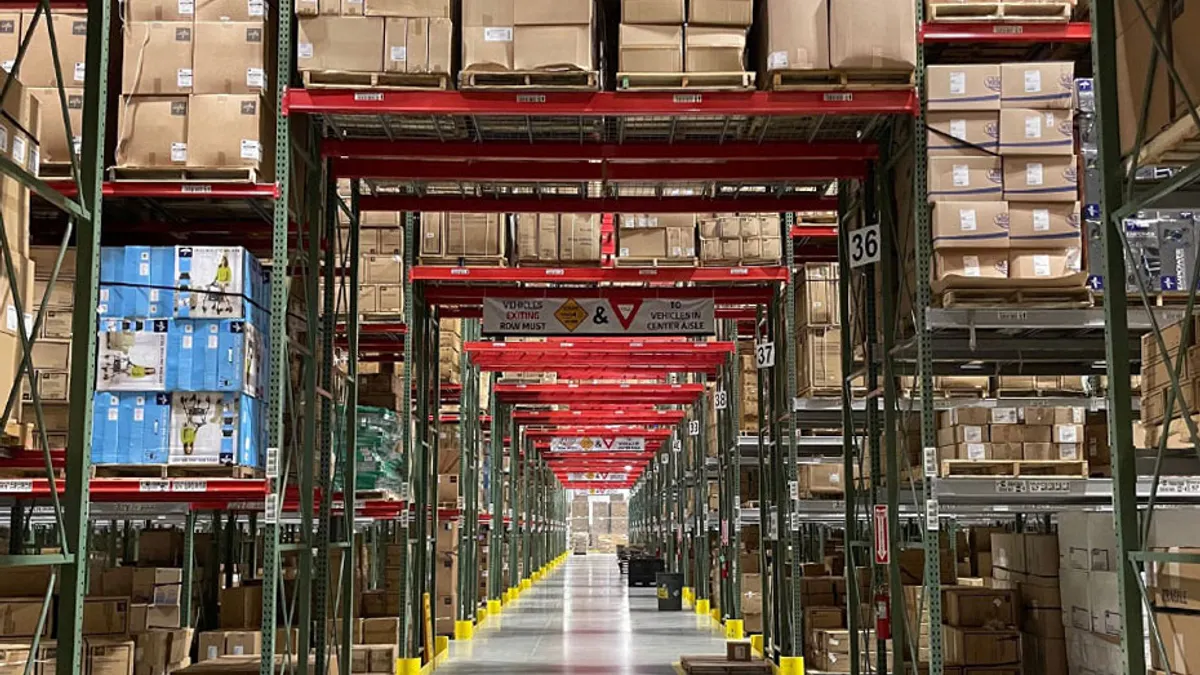
Holiday inventory management means forecasting peak demand for each SKU, ordering early enough to cover production and freight lead times, and keeping a safety buffer on the shelf so orders keep shipping through December. Most brands that run dry by mid November did plan for the holidays. They planned for November and December, and October deal events used up a chunk of that stock before the season officially started.
A typical version goes like this. A brand maps out peak season fulfillment in July, places one large purchase order, and feels good about it. Then an October promo and a few strong creator posts pull three or four weeks of sales forward. By the second week of November the best sellers are running low, and the reorder is still on a container ship somewhere in the Pacific.
Below we walk through why October changes the math, how to size holiday stock with safety stock and reorder points, and where a partner for ecommerce fulfillment services fits in. If you already do supply chain forecasting for the rest of the year, most of this will feel familiar. You'll mainly be changing the inputs.
[Image: holiday-online-spending-october-to-december.png | Alt text: Chart of 2026 US online holiday spending from October through December]
Adobe's 2026 holiday forecast puts US online spending at $95.8 billion for October alone, 8% higher than last October. Adobe's own read is that early deal events have reshaped the season, and retailers now have to plan promotions and stock around a spike that lands before November.
November and December are bigger still. Adobe expects $275.1 billion in online sales across those two months, with $47.5 billion of it during Cyber Week and more than $15 billion on Cyber Monday. The National Retail Federation forecasts holiday retail sales to grow 4.2% over last year's $972 billion, which would put the season above $1 trillion.
The share of that spending moving online keeps climbing, too. U.S. Census Bureau figures put Q2 2026 ecommerce at $340.2 billion, roughly 17.1% of all US retail and 12.2% above the same quarter in 2025.
Some rough numbers help here. Say you planned 9,000 units of your best seller for November and December, based on how it sold last year. October comes in 40% above your normal run rate thanks to a promo and a TikTok video that took off, and you ship 2,500 more units than you expected before Halloween.
You start November with 6,500 units and a plan built around 9,000. Your supplier quotes six weeks to make more, and ocean freight, port handling, and drayage add another three to five weeks. Realistically, that reorder shows up in mid January, after the season you bought it for.
The forecast in that example was probably fine for November and December. What it missed was everything October would take first.
Most holiday plans start from one number, the units you expect to sell in November and December. A more useful starting point is the date your inventory has to be on the shelf, along with how much of it still needs to be there after October. Three things tend to widen that gap in Q4.
Factories are close to capacity in late summer, and ports and carriers get busier every week heading into fall. Every leg of your pipeline inventory, from the production line to the receiving dock, moves slower than it does in spring. A reorder point built on March lead times will trigger too late in October.
Stock sitting in a trailer can't be sold. Warehouses take in a flood of inbound freight from October through early November, and some fulfillment partners fall a week or more behind on receiving. For that whole week your storefront shows those products as unavailable, even though they're physically in the building.
If you sell on Shopify, Amazon, TikTok Shop, and wholesale, every channel pulls from the same pool at the same time. Without solid multichannel inventory management, a promotion on one channel can drain stock another channel was counting on. Usually the first sign is a cancellation email going out to a customer.
Good stock control during peak comes down to five steps, and most of the difficulty is in starting them early enough.
A storewide forecast can look healthy while your top three SKUs are short and slower products are overstocked. Start with last year's October through December sales for each SKU, then adjust for what has changed since.
Use each product's own growth trend instead of the store average, and account for any promotions, bundles, or gift sets that will pull demand forward. If you've added TikTok Shop or Walmart since last Q4, last year's numbers will undercount demand. And if a SKU sold out last December, its sales history only shows what you had available, so add back the days it was out of stock.
Pick the date every holiday unit needs to be received, counted, and live in your store. For most brands, that date should come before the October deal events start. From there, work back through each lead time.
Here's how that plays out for an imported product with an October 1 sellable date:
If it's already late October and your Q4 order hasn't landed, the triage section further down covers what you can still do.
Safety stock covers the difference between what you expect to sell and what actually sells, plus any delay in restocking. Demand and lead times both swing more during peak, so the buffer should grow with them.
A common way to calculate it:
Safety stock = (maximum daily sales × maximum lead time in days) minus (average daily sales × average lead time in days)
Take one SKU with peak season numbers: average daily sales of 110 units, a best day of 140, an average lead time of 21 days, and a worst case of 35 days.
(140 × 35) minus (110 × 21) = 4,900 minus 2,310 = 2,590 units of safety stock
Reorder point = (average daily sales × average lead time) plus safety stock
(110 × 21) plus 2,590 = 4,900 units
Once on hand inventory for that SKU drops to 4,900 units, the next purchase order should go out. Start with your top sellers, and update the inputs weekly through Q4, since Cyber Week sales will look very different from early October.
When every holiday orders ships from one building, customers on the far coast pay more in postage and wait longer for delivery. Keeping stock in both an East Coast and a West Coast warehouse cuts shipping zones and parcel costs. It also gives you a backup if weather or a carrier delay hits one region.
Importers get an added benefit from Southern California warehousing near the Ports of Los Angeles and Long Beach, since containers reach the shelf days sooner. When a reorder is already cutting it close, those days count.
In most catalogs, a handful of SKUs drive most of the holiday revenue, and they deserve tighter rules. Set aside a fixed number of units per channel so one marketplace can't take everything, and keep thin SKUs out of your deepest Cyber Week discounts. Gift sets that pair a slower product with a best seller help move older stock while stretching the fast mover further.
If you sell through FBA, Amazon's inbound windows tighten in Q4. Finishing Amazon FBA prep before peak keeps your units from waiting in a receiving queue.
If you're already short, the goal is to protect the SKUs that matter most. Here's the order we'd work in:
Our founder, Payam Ahdoot, started selling online in 2010 and spent plenty of Q4 nights dealing with stockouts, oversold listings, and a warehouse that couldn't keep pace. ShipBots grew out of those years. Here's how a fulfillment partner can make holiday inventory management a lot less stressful.
A reorder point only helps if you can see stock levels as they change. ShipBots runs on a ShipHero powered WMS, and our real time inventory portal syncs with Shopify, Amazon, TikTok Shop, Walmart, and other channels. Brands using our Shopify fulfillment services see counts update as orders ship, so the storefront and the shelf stay in agreement.
We aim to turn inbound inventory into sellable stock within 48 hours of it reaching our dock, so a container that arrives Monday can be selling by Wednesday. Our fulfillment center locations cover both U.S. coasts, including Los Angeles, minutes from the Port of Long Beach, which shortens the trip for imported goods.
Every ShipBots client works with dedicated account managers based inside our warehouses. When a SKU gets close to its reorder point, the person flagging it can walk over to the bin and check. You can reach them by phone, email, Slack, or SMS, weekends included.
Peak volume puts pressure on every step of pick and pack. We hold a 99.999% accuracy rate and ship 99.9% of orders same day, and Vision AI pack verification records each order as it's packed. Accuracy matters for inventory as well, since every mispick leaves one SKU short and another showing a unit that isn't there.
Check these weekly from October through January. They're the supply chain KPIs most likely to warn you while there's still time to act.
For imported products, start in late spring or early summer, about four to six months before your first holiday promotion. That leaves time for production, ocean freight, and receiving before October deal events begin. Brands with domestic suppliers and short lead times can start later, though August is about as late as we'd recommend.
It depends on each SKU's forecast for October through December plus holiday safety stock, so a single percentage across the catalog rarely works. Build the number from your own sales history, promo calendar, and lead times, then run the safety stock and reorder point formulas for your fastest movers.
You lose the sale, and you may lose the customer to a competitor who has the item. Stockouts can also hurt marketplace rankings and waste ad spend on traffic you can't convert. If it happens, pause ads on that SKU, offer a preorder with honest dates, and point shoppers to similar products you have in stock.
Yes, more units mean more storage fees, though that cost is usually small next to the revenue a stockout loses. ShipBots uses simple, volume based fulfillment center pricing with no long term contract, so you can add space for Q4 and scale back in January.
You can, but a Q4 move carries risk, so it makes the most sense when your current partner is already causing problems. Missed ship times, inaccurate counts, and slow receiving are common signs to switch 3PLs, and they usually get worse at peak. If you do move, stage the transition and keep shipping from both locations until the new one is fully live.
Build them before peak so each set ships as its own SKU. A 3PL with kitting and assembly services can preassemble bundles from your existing stock, which speeds up pick and pack and keeps inventory counts cleaner.
That depends on the carrier and service level, and carriers publish new holiday cutoffs every year. Ground cutoffs usually land in mid December, and expedited shipping moves the deadline a few days later. Post your cutoff dates clearly on your site so customers don't have to guess.
Most brands that sell out early in the season had a forecast for November and December but no plan for October. Good holiday inventory management closes that gap. Forecast by SKU, set an in stock date and work back from it, keep real safety stock, and use a warehouse that can receive inventory within 48 hours.
If your holiday stock is already on the water, or you'd like someone to look over your plan before Cyber Week, get an instant quote and talk with a ShipBots rep about receiving, storage, and same day shipping for the season. There's no long term contract, and we'll be right there with you through peak.